

Artificial Intelligence and Machine Learning
Drive tangible value and shape the future of your organization.
After completing the course, you will be able to:
Interpret big data-related solutions.
Understand the basic concepts of predictive analytics and machine learning.
Use the scripting programming languages, including Python, to process, visualize, and analyze large data sets and implement machine-learning solutions.
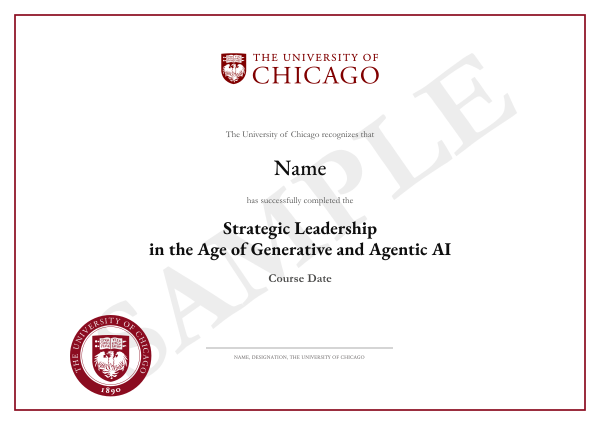
Participants who successfully complete the course will receive credentials certifying completion from the University of Chicago, including a digital badge, and become part of the UChicago network.
Course Modules
Dating with Data
Advanced data analytics, machine-learning applications, and positioning in data-led decision-making
Types of decisions and tools—regression, classification, recommendation, and retrieval
Connecting data, domain knowledge, business problems, and analytics
Answering business questions—data visualization, nuances, and modalities
Neural networks, deep learning, and reinforcement-learning concepts
Drowning in Data, Starving for Knowledge
Finding structure in data—clusters, density, and patterns
Understanding why clustering analysis is useful
Mathematical background—distance metrics, machine learning, DBSCAN, HDBSCAN, optics, and more
The Curse of Dimensionality
Feature selection, extraction, and transformation
Singular value decomposition (SVD), independent component analysis, and truncated SVD
Data transformation, projection, and dimension reduction—understanding SVD
Feature embeddings, text transformations, and topic models
Unstructured data concepts—natural language processing fundamentals
High-dimensional data visualization with UMAP and t-SNE
Non-parametric data soothing—Kernel Density Estimation
From Training to Predictive Decisions
Notation, training, and model development; loss function; learning as an optimization algorithm
Gradient descent-bayesian networks
Ridge and Lasso
Descriptive classifiers—k-nearest neighbor and Naïve Bayes algorithm
Binary class learning—logistic regression
Hinge, Jacobian, Hessian, and logarithmic loss
Evolution of Decisions through Machine Learning
Discriminative classifiers vs. descriptive classifiers
Kernel trick and support vector machines
Tree-based prediction algorithms
Extracting classification and regression rules from decision trees
Unlocking the Machine Black Box
From trees to forests—random forest theoretical approach
Voting classifiers
Bootstrap aggregation (bagging)
Boosting methods
The Wisdom of Crowds
Essentials of model interpretation and the regularization concept in machine learning
Performance evaluation metrics and cross-validation
Generalization error—overfitting vs. underfitting
Dealing with imbalanced data
Anomaly detection realm
Autoencoders—introduction to neural networks
The Future of Artificial Intelligence
Collaborative filtering
Apriori algorithm
Recommendation systems
Homogenous vs. heterogeneous networks
Graph theory—social network analysis
Learn about artificial intelligence and machine learning from industry insiders.
$140 k
#1
38.1%
Meet Your Instructor

Utku Pamuksuz, PhD
Assistant Clinical Professor and Cofounder of Inference Analytics

Taras Skavinskyy, MSc
Director of Analytics at CBRE
Unique Program Features

Live Sessions

World-Class Instructors

Hands-On Learning
This course is an excellent fit for:
Professionals who want to learn about machine learning and make the most of artificial intelligence.
Consultants looking to turn big data into machine learning to solve business problems.
Technical practitioners eager to turn data into tangible business results through machine learning.
Student Feedback
Didn't find what you were looking for? Schedule a call with one of our Program Advisors or call us at +1 315 810 9499.
Home to 101 affiliated Nobel laureates, UChicago is where learners turn ideas into impact.
Starts on