

Data Engineering Accelerated Bootcamp
Pave the way for efficient analysis, insights, and the creation of data-driven solutions.
Our Data Engineering Accelerated Bootcamp is a comprehensive training modality that focuses on the fundamental skills and real-world experience in demand today in the field of data engineering. You will emerge from this rich learning experience with a new set of technical skills, equipped to navigate cutting-edge developments and incorporate best practices into your work to thrive in multiple industries.
Data Engineering Accelerated Bootcamp Learning Outcomes
Participants will immerse themselves in the world of data engineering to acquire core analytical and technical skills and explore current and future industry trends. Technical in nature, the program provides hands-on practice in SQL, NoSQL, and Python coding using various data engineering platforms. Upon completing the program, you will be able to:
Establish a framework for data acquisition, storage, transformation, and management.
Utilize programming languages such as Python, SQL, and NoSQL to query and analyze data.
Design data warehouses to collect, store, and manage data to support business intelligence.
Comply with data privacy and security regulations to safely store and manage data.
Analyze and visualize data using Tableau reports and dashboards to communicate insights and inform decision-making.
Utilize Google Cloud services for relational databases.
Collaborate in a team to develop a data pipeline for a specific business use case.
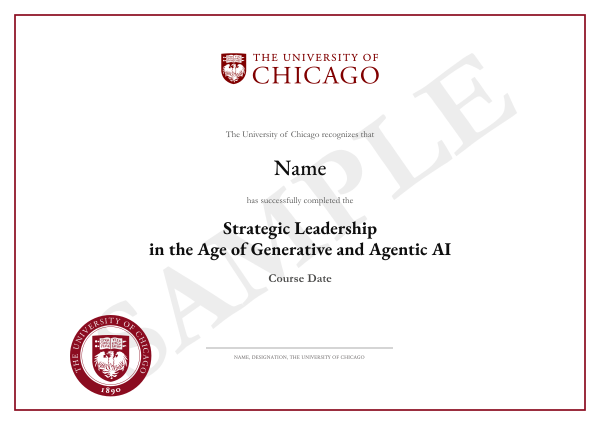
Participants who successfully complete the course will receive credentials certifying completion from the University of Chicago, including a digital badge, and become part of the UChicago network.
About the Accelerated Bootcamp Structure

In the first week, participants will be welcomed to the program by the instructor and provided with an introduction to the Data Engineering Accelerated Bootcamp, which maps out their learning journey, expectations, and milestones.

Over the next eight weeks, this highly practical course will increase your data engineering through real-world examples. You will discover and leverage the latest industry technologies, tools and trends to thrive in your workplace. The course is followed by a one-week wrap-up to help consolidate key takeaways and allow you to complete and submit any remaining assignments or forum contributions.

The final three weeks are dedicated to the final project. Participants will engage in topic-specific instructor-led interactive sessions and presentations by industry professionals. They will also create a professional development action plan through individual and group career coaching sessions.
Unique Online Bootcamp Experience


Course Experience
Understand the foundations of data systems
Prepare raw data and make it useful for analysis
Assess data quality and data security
Explain the benefits of cloud computing in data engineering
Explain basic database-related concepts and list various types of modern databases
Identify and model entities and relationships
Generate EER diagrams and normalize data
Design and build relational databases
Review the history of Structured Query Language (SQL)
Describe current industry trends
Implement various types of SQL commands
Explore Cloud SQL, a managed relational database in the Google Cloud Platform (GCP)
Implement joins, subqueries, views, and common table expressions in SQL
Select and apply data transformation functions based on different data types
Perform basic SQL administration tasks
Migrate data and database objects to Cloud SQL
Use business intelligence tooling to create insights based on a sample data set
Differentiate between analytical data stores such as data lakes, data warehouses, and data marts
Create ETL scripts to extract, transform, and load data from the source systems to target data stores
Identify and apply KPIs and other metrics in reports and dashboards
Evaluate the limitations of relational databases and the advantages of NoSQL systems for storing and managing large volumes of data
Identify use cases for NoSQL database types
Design a document database with MongoDB and manipulate, categorize, and summarize data for insights
Explore graph databases and their applications
Build a graph database using Neo4J
Use Cypher, Neo4J's graph query language to analyze and extract information from a graph database
Compare different major cloud providers
Use Linux to automate processes in GCP
Process and analyze large data sets using Hadoop and BigQuery
Before beginning the intensive program, you will have a week to consolidate key takeaways and ensure the completion of all assignments and tasks associated with the Data Engineering course.
Intensive Program Experience
During the three-week intensive program, participants will complete their final projects, discover key insights from industry speakers, and advance their professional development through career coaching and advising sessions. To guide the completion of the final project, participants will attend five instructor-led interactive sessions:
Developing Your Data Engineering Project Proposal
Foster a collaborative team and assign team roles. Identify use cases and data sets and create a proposal for a data engineering project.
Requirements and Testing Plan
Perform a gap analysis, identify requirements, and create a test strategy and testing plan.
Data Modeling, ETL, and End-to-End Platform Design
Examine source-to-target mapping and design an end-to-end platform.
Implementation and Data Visualization
Implement ETL pipeline and create stories and dashboards in Tableau.
Project Presentations and Feedback
Showcase your final project and receive feedback from a panel of data engineering professionals.
Tools and Technologies


Participant Profile
Professionals from any industry who want to understand back-end data systems and learn to design and implement them.
Individuals interested in entering or transitioning into data engineering, data science, data architecture, data modeling, or data analytics.
Participants will learn to use SQL, NoSQL, and Python coding across various data engineering platforms.
Participants will benefit from hands-on technical sessions and team-based assignments as they design original data engineering projects, evauate what approaches and techniquesare most effective, and plan the next steps for their careers.
Meet Your Instructor

Customer Success Architect, Sigma Computing
Building a Career in Data Engineering
Data engineers are in charge of building and maintaining an organization’s data infrastructure. Working with databases, data warehouses, and data pipelines, they must identify trends in data—an essential skill for managing and converting data into information that can drive results.
Data engineering is needed in practically every industry. As long as there is data, data engineers will be in demand—and this trend isn’t showing any signs of slowing. A career in data engineering is both challenging and rewarding. And with the right skill set, it may be one of the most lucrative data-focused roles.
$115k
#1
50%
Home to 101 affiliated Nobel laureates, UChicago is where learners turn ideas into impact.
Starts on