

Enterprise AI for Leaders
Scale AI initiatives to deliver measurable enterprise ROI
Lead enterprise AI from strategy to execution
15%
$ 45 billion
93%
Course modules
The Enterprise AI Landscape and the Strategic Role of Technical Leaders
The evolving enterprise AI landscape and major shifts in recent years
How AI-driven change compares to prior technology adoption cycles
The role of technical leaders in shaping enterprise AI direction
Understanding the Enterprise AI Ecosystem: Generative, Agentic and Other Models in Practice
The modern AI ecosystem, where generative and agentic AI fit, and key model types
Representative AI use cases across enterprise functions
Connecting model capabilities to practical business problems
Identifying and Understanding Headwinds to Enterprise Traction
Common patterns that slow or derail AI initiatives
Technical, organizational, and cultural sources of friction
Framing risks and challenges so they can be surfaced and addressed
Leading Workforce Transformation in the AI-Enabled Enterprise
How AI changes roles, skills, and expectations for teams
Patterns of technology adoption across early adopters, the majority, and laggards
Leadership communication and collaboration with HR and people leaders
Identifying High-Impact Opportunities for Generative and Agentic AI
Identifying promising tasks and workflows for generative and agentic AI support
Differentiating between task assistance, augmentation, and deeper automation
Assembling an initial portfolio of AI initiatives aligned with enterprise goals
Navigating the J-curve by understanding why metrics often decline before improving during AI adoption, and how to set expectations with stakeholders
Measuring Value and Accountability in Enterprise AI Programs
Principles for choosing meaningful success metrics at different stages of AI adoption
How measurement evolves as AI initiatives move from pilots to scaled deployment
Understanding why performance metrics may initially decline before improving, and how to set realistic expectations with stakeholders
Approaches for assessing internal initiatives and external AI offerings
Governance, Risk Management, and Security for Enterprise AI
Key categories of risk introduced by enterprise AI
Governance structures and acceptable use guidelines for AI programs
High-level views of technical and process guardrails that enable responsible experimentation
Capstone presentation
Participants step into the role of a newly appointed CTO at a tech company struggling to integrate AI into its operations. Drawing on the knowledge, skills, and frameworks they have learned in the course, they design a practical roadmap to guide AI adoption and execution.
Using provided organizational context, including qualitative survey inputs and workflow analyses that highlight operational bottlenecks, they produce a capstone deliverable that includes:
A categorized workstream analysis identifying high-value opportunity areas
A focused project brief outlining the initial initiative to pursue and the rationale behind it, including opportunity cost considerations
A multi-stage plan to improve adoption and traction across teams
A prioritized backlog of additional AI opportunities beyond the initial initiative
A draft internal communication, such as a Slack post, announcing and framing the transition
The course concludes with structured presentations demonstrating how AI pilots can be translated into accountable, scalable programs aligned with organizational goals
Live session schedule
Live Session | Date & Time (CST) | |
|---|---|---|
Week 1 | Module 1: The Enterprise AI Landscape | November 2, 2026 | 9:00 AM |
Week 2 | Module 2: Understanding the Enterprise AI Ecosystem | November 9, 2026 | 9:00 AM |
Week 3 | Module 3: Identifying and Understanding Headwinds to Enterprise Traction | November 16, 2026 | 9:00 AM |
Week 4 | Module 4: Leading Workforce Transformation in the AI-Enabled Enterprise | November 23, 2026 | 9:00 AM |
Week 5 | Module 5: Identifying High-Impact Opportunities for Generative and Agentic AI | November 30, 2026 | 9:00 AM |
Week 6 | Module 6: Measuring Value and Accountability in Enterprise AI Programs | December 7, 2026 | 9:00 AM |
Week 7 | Module 7: Governance, Risk Management, and Security for Enterprise AI | December 14, 2026 | 9:00 AM |
Week 8 | Translating AI Strategy into Action: Capstone Presentations and Key Takeaways | January 4, 2027 | 9:00 AM |
Note: All session timings are in CST. Session dates and timings are subject to change.
Instructor

Arnab Bose, PhD
Associate Senior Instructional Professor, Program Director of MS in Applied Data Science Online Program; Chief Scientific Officer, UST AlphaAI

Daryush Laqab
Chief Product & AI Officer, Fuel Cycle
Guest speaker

James Janega
Chief Executive Officer of Clarity Group and is an Adjunct Professor at The University of Chicago Booth School of Business.
Course features

Live Online

World-Class Instructors

Hands-On Learning

Capstone Presentation
What you'll learn
Evaluate the strategic and organizational implications of Generative AI for enterprise value creation and competitiveness.
Assess major Generative AI model types and align them with enterprise use cases across key business functions.
Identify and address the technical, organizational, and human headwinds that limit AI adoption, including overconfidence and jagged intelligence, non-determinism, vendor lock-in, and employee resistance.
Analyze workforce and talent implications of AI, including evolving competencies and leadership communication.
Apply generative and agentic AI to decompose jobs, workflows, and tasks to determine where work can be assisted, augmented, or automated.
Prioritize AI initiatives and develop a practical enterprise AI roadmap that balances ambition and feasibility.
Apply course frameworks through a Capstone Project integrating strategy, technology, talent, measurement, and governance.
Who is this course for?
Executives and senior decision makers, leading AI strategy, organizational transformation, and enterprise wide innovation.
Business and functional leaders, seeking practical frameworks to identify, prioritize, and scale AI initiatives that create measurable business value.
Technology and digital leaders, responsible for AI strategy, governance, implementation, and responsible adoption across the enterprise.
Consultants and transformation advisors, supporting organizations through enterprise AI planning, adoption, and change management.
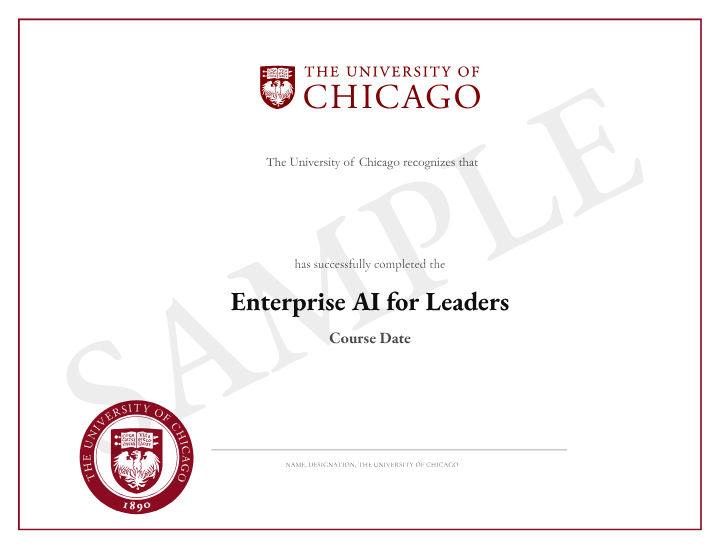
Certificate of completion
Participants who successfully complete the course will receive credentials certifying completion from the University of Chicago, including a digital badge, and become part of the UChicago network.
Note: Certificates and digital badges are issued in the name used during program registration. Images are for illustrative purposes and may be updated at the discretion of the University of Chicago.
Frequently asked questions
Are any taxes applicable to this program?
Applicable taxes will be calculated and added at checkout in accordance with country/state regulations.
Connect with a program advisor for a 1:1 Session
Didn't find what you were looking for? Schedule a call with one of our Program Advisors or call us at +1 315 810 9499.
Home to 101 affiliated Nobel laureates, UChicago is where learners turn ideas into impact.
Starts on