

Executive Program in
AI for Health Care Leaders
Lead AI strategy and adoption across the health care ecosystem
Strategic AI Leadership for the Health care Ecosystem
The Executive Program in AI for Health Care Leaders prepares senior health care leaders to guide AI strategy and adoption across clinical, operational, and enterprise settings. You will learn to evaluate AI capabilities, prioritize opportunities based on value and feasibility, build rigorous business cases, and establish the governance and operating models required for responsible adoption.
The program also explores how machine learning, large language models, multimodal AI, and AI agents are reshaping health care, helping you assess vendor claims, understand clinical and implementation risks, and make informed decisions while balancing patient safety, privacy, equity, regulatory requirements, and organizational value.
Program Takeaways
Leverage the expertise and experience of other disciplines through the foundational course, building a broader perspective on AI in health care.
Develop a rigorous understanding of AI methods and tools alongside a practical executive perspective on implementation and value creation. Leave the program with both sophisticated knowledge and practical tools to apply.
Benefit from content that is continuously reimagined and updated to reflect the latest developments and perspectives on AI in health care.
Learn alongside C-suite executives, physicians and other clinical leaders, and frontline managers, building a shared understanding of AI and its applications in health care that supports effective value delivery.
Apply your learning to develop a phased roadmap spanning people, processes, governance, and technology; align stakeholders; and present and defend recommendations through a coached capstone and boardroom simulation.
Learning Journey
Course 1: AI Strategy: From Business Priorities to AI Roadmap
6 weeks | Asynchronous
Module 1: AI Essentials for Business Leaders
Focus: Build a practical, precise understanding of core AI concepts and what they mean for business.
Key Topics: AI terminology for business leaders and how AI relates to adjacent technologies; the evolution of AI and why now (compute, data, algorithms); predictive, generative, and agentic AI; capabilities, limitations, and risks; AI's role in strategy, competitive advantage, and organizational change; the Human + AI spectrum; the business leader's role in AI adoption
Module 2: Business and AI Strategy Foundations
Focus: Connect AI capabilities to business strategy, priorities, and the metrics that measure success.
Key Topics: Foundational principles of business strategy (mission, vision, strategy, tactics, values); strategic frameworks for locating AI opportunity (Value Chain, Five Forces, SWOT); scope of AI deployment (geographic, business unit, functional); aligning AI strategy with business goals; metrics that matter (leading and lagging indicators, the seven building-block framework); AI-driven KPIs (descriptive, predictive, prescriptive)
Module 3: AI as a Strategic Enabler
Focus: Examine how AI creates competitive advantage across industries and how to gauge an organization's AI maturity.
Key Topics: Sources of competitive advantage (cost leadership, differentiation, focus); how AI enhances advantage (process efficiency, decision-making, customer-centric innovation); AI applications across industries; example AI strategies aligned to business strategy; AI maturity models and their dimensions; assessing organizational AI maturity on a five-point scale
Module 4: AI Initiative Evaluation and Prioritization
Focus: Identify, evaluate, and prioritize AI opportunities into a sequenced portfolio.
Key Topics: Identifying AI opportunities with business frameworks (driver trees, value chains); challenges addressable by AI across industries; scoring opportunities on business value and feasibility; prioritization frameworks and the value/feasibility 2×2; sequencing a portfolio to balance quick wins with longer-term strategic value; re-scoring as conditions change
Module 5: Building the AI Business Case
Focus: Build a rigorous business case for an AI initiative, considering economics, value, and risk.
Key Topics: Orchestrating the business-case process (roles, stakeholders, evaluation criteria); quantifying costs and benefits (ROI, NPV, payback, breakeven, IRR); tangible and intangible costs and benefits; the data-science pipeline and AI development timeline; identifying and assessing AI-related risk (technical, operational, ethical, strategic, financial, regulatory); risk mitigation strategies; assembling the business case
Module 6: Creating the AI Capability
Focus: Develop an AI capability roadmap and learn placement and orchestration from real-world cases.
Key Topics: Placing the AI capability within the organization; AI operating tiers (local, regional, global) and orchestration models (central, parent-led, federated, local); building the capability across people, process, governance, and technology; defining a target state driven by business need; the AI capability roadmap; capability-building lessons from real-world case studies
Course 2: AI in Health Care: Strategy, Governance, and Transformation
6 weeks | Live online
Module 1: State of the Industry: The Current AI Landscape in Health Care
Focus: Understand where AI adoption in health care actually stands, and what past technology cycles predict about this one.
Key Topics: History of machine learning and AI in health care; instructive analogs from past technology transitions including EHRs and genomics; cross-industry lessons from finance, manufacturing, and retail; current high-value use cases; the hype cycle and where promises diverge from results; core vocabulary and mental models for non-technical leaders
Module 2: Under the Hood: What AI Is and Is Not, for Clinical Risk
Focus: Build enough technical fluency to test a vendor's claims and judge whether an approach fits the clinical risk involved.
Key Topics: AI, machine learning, deep learning, and large language models distinguished; how LLMs work, intuition without equations; hallucination, bias, data dependency, and brittleness; what AI cannot do — reasoning gaps, causality, accountability; emerging capabilities including multimodal AI, agents, and reasoning models; testing vendor claims against technical reality; the questions to ask before commitment
Module 3: Governance, Oversight, and Risk
Focus: Decide who owns AI accountability in your organization and build the oversight to support it.
Key Topics: Centralized, federated, and hybrid governance models; Chief AI Officer versus embedding AI in existing functions; IT versus clinical ownership; cross-functional AI committees including clinical, legal, compliance, and patient and community voice; the internal resources and expertise a health system needs to oversee AI; privacy and HIPAA in the age of LLMs; cybersecurity risks specific to AI systems; FDA, CMS, state law, and emerging federal frameworks; liability, ethics, bias, and equity in clinical AI
Module 4: Strategy, Prioritization, and Partnerships
Focus: Prioritize AI initiatives against organizational goals, and decide whether to build, buy, or partner.
Key Topics: What a real AI strategy looks like versus a vision statement; problem-driven prioritization across back office, revenue cycle, clinical operations, and patient experience; roadmaps with milestones and dependencies; communicating to boards, clinical staff, and community partners; build versus buy versus partner by organizational maturity; evaluating AI vendors beyond the demo; contracts, IP ownership, and health data rights; co-development models, investment and venture approaches, and avoiding lock-in
Module 5: Making It Work: Implementation, Adoption, and Measurement
Focus: Structure a rollout clinicians will adopt, and measure whether it created value.
Key Topics: Why most AI implementations fail and how to prevent it; implementation science applied to AI; human-centered design and co-design with clinicians and staff; change management for AI, addressing fear and building trust; measuring what matters across clinical, operational, financial, equity, and staff-experience dimensions; case deep dive on ambient documentation and lessons from real deployments
Module 6: Looking Forward: Workforce, Literacy, and Leadership
Focus: Prepare the organization for what comes next, and present your capstone.
Key Topics: Emerging AI capabilities and their likely health care applications over the next several years; workforce transformation including augmentation, displacement, and reskilling; building organizational AI literacy at every level; the leader's role in vision, culture, and sustained organizational learning; capstone presentations and peer feedback
*The curriculum and topics may be updated by UChicago as required.
Three-Day In-Person Symposium in Chicago
Day 1: Cross-Domain Foundations
Participants from across the University of Chicago's AI certificate portfolio, including health care, law, and finance, convene shared sessions on what the technology can and cannot do, and on where it is heading. Sessions mix technical grounding with strategic implication, designed for decision-makers rather than builders.
Day 2: Executive Leadership
The cross-domain cohort continues with sessions on leading an organization through an AI transition, with topics including governance and accountability, aligning boards and stakeholders, and the judgment calls that recur regardless of sector. Working through these questions alongside a general counsel or a CFO is the point - most of the people who will challenge your AI proposal at home do not work in health care.
Day 3: Health Care Capstone
Participants return to their health care cohort to present their capstones and defend their recommendations before faculty and peers, closing with structured feedback and discussion of what it takes to move the proposal forward at home.
*Attendance at all in-person symposium sessions is mandatory. Session topics and schedules are subject to change.
Capstone Project
The capstone project integrates learning from the program through applied projects focused on AI strategy alignment and strategy roadmap development. Participants apply program frameworks to develop AI strategies, prioritize initiatives, and present their recommendations through board-level strategy presentations and boardroom simulation.
Program Highlights

Weekly interactive sessions with UChicago instructors exploring AI strategy, health care applications, and executive leadership challenges

Strategic frameworks, peer discussions, and practical applications to evaluate AI opportunities, governance approaches, and enterprise adoption decisions

A hands-on capstone project focused on AI strategy alignment, roadmap development, and board-level strategy presentation

A three-day in-person symposium in Chicago featuring frontier AI trends, cross-industry perspectives, health care-specific challenges, and boardroom simulation

Executive-level discussions on AI governance, responsible adoption, implementation, and value measurement across health care environments

Earn a Certificate of Completion and digital badge from the University of Chicago upon successful completion of the program
Program Benefits
Upon successful completion of the program, you will receive select program benefits from the University of Chicago. These include:
Networking Opportunities
Exclusive LinkedIn access for continued professional connections.
Quarterly Speed Networking Nights hosted via Zoom.
Professional Development Resources
Resume Review Workshops: Offered once annually in a webinar/workshop hybrid format, allowing you to collaborate and exchange industry-specific insights.
Professional Development Webinars: Delivered in collaboration with the Career Transitions Center (CTC), focusing on professional growth and workplace trends.
*Program benefits are subject to change
This Program Is an Excellent Fit for You If You Are:
This program is designed for health care and AI leaders guiding strategy, adoption, governance and value creation.
Health System C-Suite: CEOs, COOs, CMOs, CNOs, CFOs, CSOs, CIOs, CAIOs, business unit leaders, and direct reports building AI decision-making fluency and strategic advantage
Academic Health Leaders: Deans, associate deans, department chairs, section chiefs, and research directors leading AI integration
Clinicians in Leadership Roles: Physicians, nurses, and allied health leaders overseeing clinical AI adoption and oversight
Industry Partners: Executives across pharma, insurance, medical devices, and health IT seeking insight into health system AI decision-making
10+ years of relevant work experience is required for this program.
Meet the Instructors

Roger L. Moore, Jr., MBA
Associate Clinical Professor

Samuel L. Volchenboum, MD, PhD, MS
Associate Dean of Master’s Education | Professor of Pediatrics | Director, Data for the Common Good | Section Chief, Section of Biomedical Informatics | Associate Director, In...

Stephen G. Weber, MD, ScM
Professor, Section of Infectious Diseases & Global Health | Associate Vice Chair for Faculty Development, Department of Medicine | Director of Leadership and Executive Program...
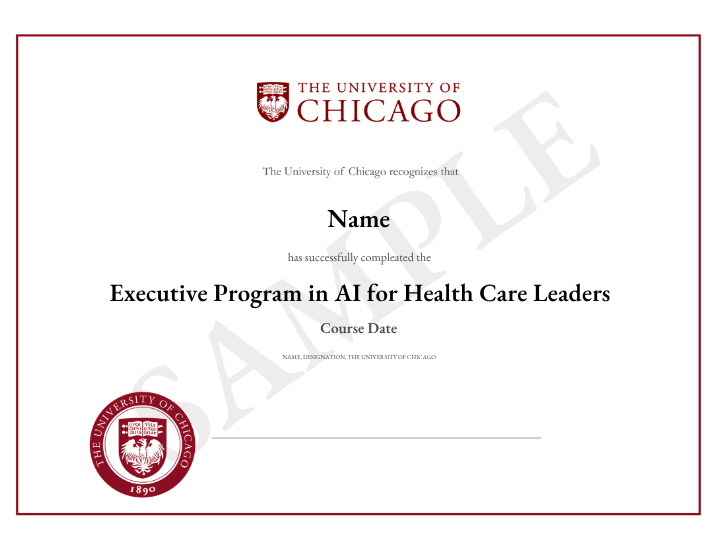
Certificate
Upon successful completion of the Executive Program in AI for Health Care Leaders, participants will receive a Certificate of Completion from the University of Chicago.
Participants will also receive a digital credential that can be shared on professional platforms to showcase their achievement.
Note: Certificates and digital badges are issued in the name used during program registration. Images are for illustrative purposes and may be updated at the discretion of University of Chicago
Frequently Asked Questions
What is the format of the program?
The learning journey combines asynchronous online learning, live online sessions, applied projects, and a three-day in-person symposium at UChicago.
What is the total duration?
The program lasts 24 weeks and includes a three-day in-person symposium in Chicago.
What is the program fee?
The program fee is US $15,000.
Who should apply?
This program is designed for health care and AI leaders responsible for strategy, adoption, governance, and value creation. This includes senior executives, clinical leaders, academic and research leaders, executives across pharma, insurance, medical devices, and health IT, as well as innovation, strategy, AI, and functional leaders. It is also relevant for senior consultants and advisors guiding AI strategy, operating model redesign, governance, and responsible adoption.
A minimum of 10 years of relevant work experience is required.
What will I learn?
You will learn to evaluate AI capabilities, prioritize high-value initiatives, build business cases, and develop a phased enterprise AI roadmap. You will also assess vendors and partnerships, establish governance, manage health care-specific risks, align stakeholders, and measure clinical, operational, financial, and equity outcomes.
What will I receive upon completion?
Upon successful completion of the program, you will receive a certificate from The University of Chicago and a digital badge that can be shared on LinkedIn or added to a professional portfolio.
What happens during the in-person symposium?
The three-day symposium in Chicago combines frontier AI insights, cross-industry peer exchange, and executive decision-making. Participants explore governance and stakeholder alignment before presenting and defending their capstone recommendations in a boardroom simulation.
How do I apply?
Complete the program application form to begin the admissions process. Additional application and enrollment requirements will be provided by the admissions team.
Are any taxes applicable to this program?
Applicable taxes will be calculated and added at checkout in accordance with country, state, and local regulations.
Connect with a Program Advisor for a 1:1 session
Didn't find what you were looking for? Schedule a call with one of our Program Advisors or call us at +1 315 810 9499.
Home to 101 affiliated Nobel laureates, UChicago is where learners turn ideas into impact.
Starts on